

I find that choosing the best weather stations with an app and WiFi comes down to more than just checking the temperature outside. These devices give me real time access to highly localized weather data, delivered straight to my phone or computer, which makes it much easier to plan my day, protect my home, and even manage outdoor activities or smart devices.
The combination of wireless sensors, remote monitoring, and smart alerts transforms weather tracking into something far more practical and interactive than traditional forecasts. In this guide, I will explore the key features that matter most, highlight top picks based on performance and usability, walk through a clear buying guide, and finish with helpful FAQs to make your decision easier.
Best Weather Stations With An APP And WI-FI
1) Ambient Weather WS-2000 Smart Weather Station with WiFi

The Ambient Weather WS-2000 Smart Weather Station with WiFi stands out as one of the most capable choices for anyone looking for a weather station with app connectivity and WiFi integration. It is designed for users who want detailed, real time insight into both indoor and outdoor conditions, with a strong focus on data accuracy, smart connectivity, and long term tracking.
From backyard weather monitoring to home automation use, it offers a wide range of tools that go far beyond basic forecasting.
A key strength of this system is its all in one wireless sensor array, which continuously measures wind speed and direction, temperature, humidity, rainfall, ultraviolet levels, and solar radiation. It also calculates useful derived metrics such as wind chill, heat index, dew point, and feels like temperature.
The sensor suite is solar powered with a supercapacitor and includes battery backup support, which helps maintain stable operation even in low light conditions. With wireless transmission reaching up to a long line of sight range, it is well suited for residential outdoor installation.
The indoor console delivers a clear and detailed viewing experience through a full color TFT LCD screen with high resolution. It displays live weather readings along with moon phase, sunrise and sunset data, and forecast icons.
Users can also view historical records with time stamped minimum and maximum values. The interface supports both imperial and metric units and allows calibration, making it flexible for different user preferences and regions. Alarm settings with audible alerts add an extra layer of awareness for changing conditions.
Connectivity is one of the strongest advantages of this model. It uses WiFi to transmit data to multiple platforms including the Ambient Weather Network, Weather Underground, WeatherCloud, and WeatherBug. It also integrates with Alexa, Google Assistant, and IFTTT, allowing users to build automation routines based on real time weather changes.
For advanced users, there is also developer access through a JSON API, enabling custom applications and deeper data integration.
The system includes an AWN Plus subscription for one year, which unlocks advanced graphing tools, degree day tiles, SMS alerts, premium map layers, and layout customization features. While the subscription enhances the experience, the core app and basic monitoring features remain available without additional cost, which makes it accessible even without ongoing payments.
Pros
- Comprehensive all in one sensor array measuring multiple weather variable
- Strong WiFi connectivity with support for major weather networks
- High resolution color display with detailed historical tracking
- Smart home integration with Alexa, Google Assistant, and IFTTT
- Solar powered outdoor sensor with backup battery support
- Flexible unit settings with calibration options
Cons
- Advanced AWN Plus features require subscription after the included period
2) Tempest Weather Station
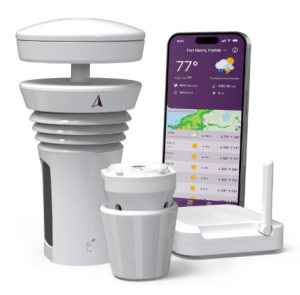
The Tempest Weather Station is widely regarded as one of the most advanced options for users looking for a weather station with app and WiFi connectivity. It combines modern sensor technology, smart forecasting, and low maintenance design into a single compact system.
Trusted by major publications such as Better Homes & Gardens, Popular Mechanics, The Spruce, and Wired, it has also gained a strong following among more than 85,000 users who rely on it for accurate, hyper local weather insights.
A major strength of this system is its all in one sensing approach. Instead of relying on multiple moving components, it uses a single outdoor device to measure temperature, humidity, barometric pressure, wind speed and direction, dew point, solar radiation, UV index, rainfall, and lightning activity.
This unified design allows it to deliver consistent readings while keeping installation simple. Because it is solar powered and designed without mechanical moving parts, it requires very little maintenance and is built for long term outdoor durability.
The device transmits weather data wirelessly at a range of over 1,000 feet, sending updates every few seconds for near real time monitoring. This makes it especially useful for users who want immediate awareness of changing conditions.
Setup is straightforward through the Tempest app, where users connect the device to WiFi and follow guided steps. Once installed, the system provides continuous updates through both the mobile app and web dashboard.
Another strong advantage is its smart forecasting capability. The system uses proprietary machine learning to generate highly localized forecasts and alerts based on real time environmental conditions. This allows users to receive more precise predictions than standard regional weather services. It also stores historical data, enabling users to track long term patterns and trends directly from the app.
Integration with smart home systems adds further value. The device works with Amazon Alexa, Rachio, IFTTT, and other platforms, allowing users to automate tasks such as irrigation scheduling, lighting control, and thermostat adjustments based on live weather conditions. This makes it not only a monitoring tool but also a practical part of a connected home setup.
Pros
- All in one sensor design measuring a wide range of weather conditions
- Very low maintenance due to no moving parts
- Fast real time updates every few seconds
- Long wireless transmission range up to 1,000+ feet
- Strong smart home integration with Alexa, IFTTT, and Rachio
- Easy installation with simple WiFi setup through the app
- AI driven forecasting with localized predictions and alerts
Cons
- Higher reliance on app and cloud services for full functionality
3) Ambient Weather WS-2902 WiFi Smart Weather Station
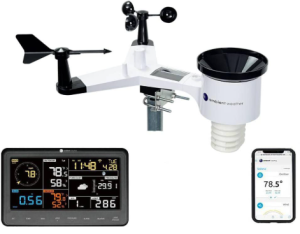
The Ambient Weather WS-2902 WiFi Smart Weather Station is widely considered one of the most practical and feature rich options for anyone looking for a weather station with an app and WiFi connectivity.
It balances advanced environmental monitoring with smart home integration and remains accessible enough for everyday users who want accurate backyard weather data without unnecessary complexity. Positioned in a competitive mid range category, it delivers strong value through its combination of hardware capability and cloud based tools.
This system includes a complete Osprey sensor array paired with a bright LCD color display console. The outdoor unit measures a wide range of conditions including temperature, humidity, wind speed and direction, rainfall, barometric pressure, solar radiation, and UV levels.
It also calculates useful metrics such as dew point, wind chill, heat index, and rainfall rate. The tipping bucket rain gauge and wind instruments provide reliable mechanical measurements, while the solar powered design with battery backup helps maintain continuous operation in changing weather conditions.
The display console is designed for clear readability, offering a compact but vibrant color interface that presents live readings and environmental trends in real time. It supports both imperial and metric units and allows calibration for more precise local accuracy.
The console also includes backup battery support, ensuring data visibility even during power interruptions. This makes it suitable for home use where quick weather checks are needed without relying solely on a mobile device.
Connectivity is one of the strongest aspects of this weather station. With enhanced WiFi support, it transmits data to the Ambient Weather Network, giving users access to one of the largest personal weather station platforms available.
It also integrates with Alexa, Google Home, and IFTTT, allowing users to automate smart home devices based on real time environmental changes. This can include adjusting irrigation systems, triggering alerts, or managing indoor climate systems depending on weather conditions.
The included AWN Plus subscription adds another layer of depth to the experience. It provides advanced graphing tools, customizable dashboards, SMS alerts, premium map overlays such as air quality and wildfire tracking, and extended historical data access.
These tools are especially useful for users who want to analyze long term weather patterns or set up detailed monitoring systems. While the subscription enhances functionality, the core monitoring and app access remain available without additional cost.
Pros
- Comprehensive sensor array measuring a wide range of weather conditions
- Strong WiFi connectivity with access to a large global weather network
- Smart home compatibility with Alexa, Google Home, and IFTTT
- Clear and easy to read color display console
- Solar powered outdoor unit with battery backup for reliability
- Advanced data tools included through AWN Plus subscription
- Good balance of professional features and user friendly setup
Cons
- AWN Plus advanced features require subscription after included period
4) Ambient Weather WS-5000 Ultrasonic Smart Weather Station
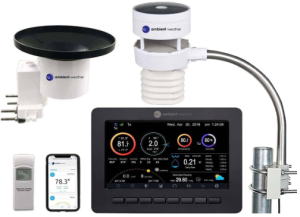
The Ambient Weather WS-5000 Ultrasonic Smart Weather Station is designed for users who want a more advanced and highly responsive weather monitoring system with strong app and WiFi capabilities. It builds on the idea of real time environmental awareness by combining ultrasonic sensing technology with smart home integration and cloud based data sharing.
This makes it one of the more premium choices in the Ambient Weather lineup for those who want fast, precise, and highly connected weather tracking.
A key strength of this system is its all in one ultrasonic sensor array, which eliminates moving parts entirely. This design allows for rapid updates every five seconds, delivering highly responsive readings across multiple weather conditions.
The system measures wind speed and direction, temperature, humidity, barometric pressure, and rainfall using an extra large rain cup designed for improved accuracy. Because the sensor unit is fully wireless and compact, it can be placed closer to the ground for easier maintenance while still maintaining reliable performance.
The inclusion of a TFT full color LCD display provides a clear and detailed visual interface for monitoring conditions indoors. It works alongside a separate indoor and outdoor thermo hygrometer barometer unit to deliver comprehensive environmental insights.
Users can view live data, trends, and system readings directly on the display while also accessing the same information remotely through the app and connected platforms.
Connectivity is a major strength of this weather station. Enhanced WiFi allows data to be transmitted to the Ambient Weather Network, which is one of the largest personal weather station ecosystems available.
From there, users can customize dashboards, share local weather conditions, and participate in broader weather data communities. Integration with Alexa, Google Home, and IFTTT also enables automation, allowing users to trigger smart home actions based on changing weather conditions.
The system is designed to support both casual users and more advanced weather enthusiasts who want fast refresh rates and detailed environmental tracking.
With real time updates every few seconds, it offers a more immediate picture of changing conditions compared to many traditional sensor systems. The absence of moving mechanical parts also reduces wear over time, which supports long term reliability.
Pros
- Ultrasonic sensor design with no moving parts for low maintenance
- Very fast updates every five seconds for real time monitoring
- Accurate rain measurement using extra large rain cup
- Strong WiFi connectivity with Ambient Weather Network integration
- Smart home compatibility with Alexa, Google Home, and IFTTT
- Flexible installation options with wireless sensor placement
- Community features for sharing and customizing weather data
Cons
- Higher price compared to entry level weather stations
5) Sainlogic SA9 Plus Smart WiFi Weather Stations
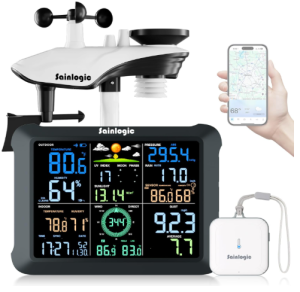
The Sainlogic SA9 Plus Smart WiFi Weather Station is positioned as a feature packed option for users who want detailed environmental monitoring combined with app based control and WiFi connectivity.
It blends smart forecasting tools, multi sensor outdoor monitoring, and a large indoor display into a system designed for both home users and hobbyist weather enthusiasts. With its focus on accessibility and data depth, it fits well among modern connected weather stations that prioritize real time insights and remote access.
A key strength of this system is its Weatherseed app integration, which provides continuous AI powered forecasts and real time alerts based on user defined thresholds. Users can set notifications for changes in temperature and humidity, making it useful for gardening, greenhouse management, travel planning, and environmental monitoring in spaces like basements or RVs.
The app also supports up to two years of historical data storage, with the ability to export datasets for deeper analysis, which adds value for users who like tracking long term weather trends.
The outdoor monitoring system uses a 7 in 1 sensor array that measures UV and sunlight, wind speed and direction, rainfall, temperature, humidity, and barometric pressure. This is paired with an indoor thermo hygrometer to give a complete view of both indoor and outdoor conditions.
The system supports real time WiFi synchronization, allowing users to check conditions remotely at any time. It is designed to maintain strong wireless connectivity across typical residential environments, including backyards, patios, and rural properties.
The indoor display is another important part of the experience. It features an 8.5 inch screen with bold text and a three level adjustable backlight, making it easy to read in different lighting conditions. The display presents a wide range of data including wind conditions, rainfall, UV index, dew point, barometric pressure, moon phase, and time.
This makes it suitable for users who prefer quick visual access to weather data without needing to rely on a smartphone at all times.
Setup is designed to be straightforward, with the outdoor sensor unit easy to mount on fences, roofs, poles, or flat surfaces using basic tools. This makes it accessible even for users who are not technically inclined. The system also includes multiple support channels, including phone and email assistance, which adds reassurance for first time users who may need guidance during installation or configuration.
Pros
- AI powered Weatherseed app with real time alerts and forecasting
- Supports up to two years of historical data with export options
- Comprehensive 7 in 1 outdoor sensor array
- Large 8.5 inch display with clear and adjustable brightness
- Easy installation suitable for beginners
- WiFi and Bluetooth connectivity with optional Weather Underground integration
- Strong support options including phone and email assistance
Cons
- App dependent features require stable internet connection
6) AcuRite Atlas Professional Weather Station
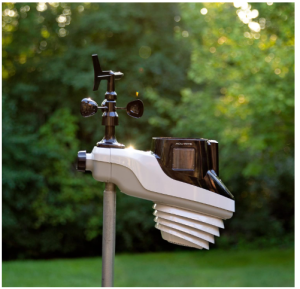
The AcuRite Atlas Professional Weather Station is designed for users who want a highly detailed and professional grade weather monitoring system with strong app and WiFi connectivity. It focuses on delivering accurate, real time environmental data while also supporting smart alerts, remote access, and long term tracking.
Built by a long established company known for durable instruments, it positions itself as a serious option for home users, RV owners, and weather enthusiasts who want deeper insight into local conditions.
This system provides a wide range of real time measurements through its wireless outdoor sensor array, which includes thermometers, hygrometers, a barometer, anemometers, UV and light sensors, and a rain gauge. It captures indoor and outdoor temperature and humidity, wind speed and direction, barometric pressure, rainfall totals, UV levels, and light intensity.
In addition, it supports lightning detection from up to 25 miles away, which adds an important safety feature for outdoor planning and severe weather awareness. With over 20 data points available, it offers one of the more complete monitoring experiences in its category.
Connectivity is handled through AcuRite NOW, which enables direct WiFi transmission for remote access via smartphone or desktop. This allows users to check live weather conditions from virtually anywhere. The system also integrates with Weather Underground, giving users the ability to share data with a global network of personal weather stations.
This community based feature is useful for those who want to compare local conditions or contribute to broader weather datasets.
A major advantage of this station is its self calibrating forecasting technology. It uses elevation and atmospheric pressure data to generate a localized 12 hour forecast that adjusts based on real conditions at the installation site.
This makes predictions more relevant to the user’s immediate environment compared to generalized regional forecasts. The system also includes historical data tracking, allowing users to review past trends and weather patterns over time.
The indoor display is designed for clarity and usability, offering a high definition screen that remains readable from different angles. It includes battery backup support to preserve settings and data during power outages, ensuring continuity of information. The display can be placed on a tabletop or mounted on a wall, providing flexible installation options for different home setups.
Installation is straightforward, with mounting hardware included for the outdoor sensor unit. The system is designed for both beginners and experienced users, offering a balance between professional level data and accessible setup. Backed by a long standing US based company, it also benefits from established customer support and a reputation for long lasting product quality.
Pros
- Comprehensive sensor array with more than 20 weather data points
- Lightning detection up to 25 miles for added safety awareness
- WiFi connectivity with AcuRite NOW for remote monitoring
- Integration with Weather Underground community network
- Self calibrating forecasting for localized predictions
- High definition display with battery backup support
- Easy installation with flexible mounting options
- Strong brand reputation with long term durability focus
Cons
- Advanced features may require time to fully understand and use
7) AcuRite Iris (5-in-1) Home Weather Station
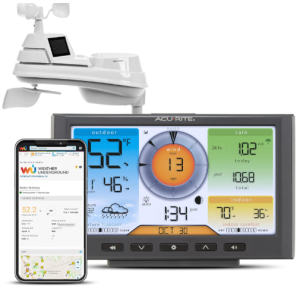
The AcuRite Iris 5 in 1 Home Weather Station is a practical and accessible choice for users who want reliable weather tracking with app and WiFi connectivity without unnecessary complexity. It focuses on delivering essential environmental readings in a simple, connected format while still offering enough depth for users who want to monitor local conditions closely.
Its reputation as a budget friendly smart weather station makes it a popular option for households, hobbyists, and anyone starting with home weather monitoring.
This system provides real time indoor and outdoor weather data through a wireless outdoor sensor that combines multiple instruments into a single unit. It measures temperature, humidity, wind speed and direction, barometric pressure, and rainfall, giving users a complete snapshot of local conditions.
It also calculates derived metrics such as heat index, dew point, wind chill, and rainfall history, which adds useful context for understanding changing weather patterns. With over 25 data points available, it offers more depth than many entry level stations.
The indoor display is designed for everyday convenience, featuring a large color LCD screen that shows time, date, and live weather conditions in a clear format. An adjustable dimmer allows users to adapt brightness for different lighting environments, making it easy to read at night or during the day.
This makes the system suitable for placement in common living areas where quick visual access to weather updates is useful.
Connectivity is handled through WiFi integration with Weather Underground, allowing users to remotely monitor their station and contribute data to a global network of personal weather stations. This feature is especially valuable for users who want to compare local readings or track broader weather trends.
The system also supports personalized forecasting by combining elevation data with barometric pressure readings, producing short term predictions based on local conditions rather than generalized regional forecasts.
Setup is one of the most user friendly aspects of this weather station. The process involves installing batteries and mounting the outdoor sensor using the included bracket, making it suitable even for first time users. Once installed, the system begins transmitting data wirelessly to the indoor display and connected app services, allowing for quick access to live weather information.
Pros
- Simple and fast installation suitable for beginners
- Over 25 weather data points for detailed local monitoring
- WiFi connectivity with Weather Underground integration
- Large color display with adjustable brightness
- Personalized 12 hour weather forecasting based on local conditions
- Wireless all in one outdoor sensor design
- Strong value for a smart WiFi weather station
- Backed by a long established US based company with reliable support
Cons
- Lacks advanced smart home automation features found in higher end models
8) VEVOR 7-in-1 Wi-Fi Weather Station with APP

The VEVOR 7 in 1 Wi Fi Weather Station with APP is designed as an affordable yet capable option for users who want app based weather monitoring combined with WiFi connectivity. It focuses on delivering a wide range of environmental data through a single outdoor sensor system while keeping setup and daily use straightforward.
With its balance of smart app control, solar powered operation, and broad measurement capability, it fits well for homeowners, gardeners, and small farm users who want practical weather insights without a complex setup.
This system uses a 7 in 1 outdoor sensor that measures temperature, humidity, rainfall, wind speed and direction, sunlight, and dew point, while also providing moon phase tracking and short term 6 to 12 hour forecasts.
These readings are displayed on both the outdoor sensor system and the indoor console, giving users a complete overview of current and upcoming conditions. The sensor has been upgraded with improved water resistance and internal component protection, which helps it perform more reliably in outdoor environments.
The indoor display is built around a 7.5 inch high definition screen that shows weather data clearly in different lighting conditions. With four adjustable brightness levels, it can be comfortably used in living rooms, bedrooms, or office spaces at any time of day.
The layout presents key environmental readings in a structured format, allowing users to quickly understand current conditions without needing to rely solely on the mobile app.
Connectivity is handled through Smart Life app integration, which allows users to monitor, store, analyze, and share weather data remotely. The system supports only 2.4 GHz WiFi and requires the power adapter to remain connected for stable synchronization.
Unlike some competing systems, it does not require external weather websites for registration and avoids subscription fees or ads, making it a more direct and simplified digital experience for users who prefer straightforward app control.
The outdoor sensor supports long range transmission of up to 492 feet, making it suitable for larger properties such as gardens, rooftops, or small farms. It is designed for flexible installation, though placement away from interference sources like metal fences, power lines, or electronic equipment is recommended for optimal performance.
The system is also solar powered, with battery backup for nighttime or low light conditions, helping reduce maintenance and power dependency.
Pros
- Wide 7 in 1 sensor coverage including sunlight and moon phase tracking
- Smart Life app integration with no subscription or ads
- Large 7.5 inch display with adjustable brightness levels
- Long wireless transmission range suitable for large outdoor spaces
- Solar powered with battery backup for continuous operation
- Improved water resistance and upgraded internal components
- Straightforward installation with simplified setup process
Cons
- Requires 2.4 GHz WiFi only, no 5 GHz support
9) Drusine 16-in-1 WiFi Weather Station with Air Quality Monitor
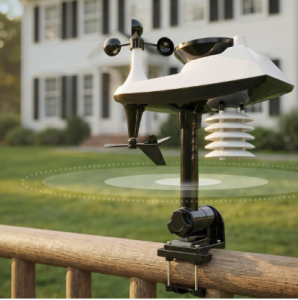
The Drusine 16 in 1 WiFi Weather Station with Air Quality Monitor is a feature dense option designed for users who want both detailed weather tracking and air quality monitoring in a single connected system. It goes beyond standard home weather stations by combining environmental sensing with smart app access, making it suitable for households that want a broader understanding of outdoor conditions, including safety related air quality data.
This system delivers an unusually wide range of measurements through its 16 in 1 sensor setup. It tracks temperature, humidity, barometric pressure, wind speed and direction, rainfall, UV index, and light intensity, while also adding TVOC air quality detection.
This combination allows users to monitor not only weather patterns but also environmental health factors such as air safety and sun exposure. The high precision sensors provide temperature accuracy within ±0.5℃ and humidity accuracy within ±2% RH, helping ensure reliable readings for both everyday use and more detailed observation.
Connectivity is handled through WiFi integration with the TUYA app, which allows users to view real time data, access historical trends, and review rainfall records from anywhere. The system operates on 2.4 GHz WiFi and syncs with a large color indoor display that includes adjustable brightness and night mode for easy reading in different lighting conditions.
Additional features such as dual alarms, a calendar extending to 2099, and sunrise and sunset tracking turn the display into a multifunctional home information hub.
The outdoor sensor is designed for convenience and durability, offering a wireless transmission range of up to 300 feet in open areas. It uses 433.92 MHz RF transmission for stable connectivity across typical residential environments such as gardens, patios, and greenhouses.
Setup is straightforward, requiring only basic mounting and app pairing, with most users able to complete installation in just a few minutes without technical difficulty.
Durability is another strong point of this system. The outdoor unit carries an IPX5 waterproof rating and is built to withstand a wide temperature range from -40℃ to 70℃. This makes it suitable for year round outdoor use in varied climates.
It also supports up to two years of data storage with export options, giving users the ability to analyze long term weather and environmental trends over time.
Pros
- 16 in 1 monitoring including air quality, UV, and light intensity
- TUYA app integration with remote real time and historical access
- High precision sensors for temperature, humidity, and rainfall
- Large color display with night mode and adjustable brightness
- Long wireless transmission range suitable for most properties
- Easy setup with quick installation process
- IPX5 weather resistant design for outdoor durability
- Long term data storage with export capability
Cons
- Requires 2.4 GHz WiFi only, no support for 5 GHz networks
Next read: 9 Best Weather Stations With Outdoor Sensors
Factors To Consider When Choosing The Best Weather Stations With An APP And WI-FI
Choosing the best weather stations with an app and WiFi requires balancing accuracy, connectivity, usability, and long term reliability. Based on the systems discussed, there are several key factors that consistently determine whether a weather station performs well in real world use.
1. Sensor accuracy and measurement range
One of the most important factors is how accurately the system measures environmental conditions. A strong weather station should capture temperature, humidity, wind speed and direction, rainfall, barometric pressure, and ideally additional metrics such as UV index or solar radiation.
Accuracy is especially important for users who rely on data for gardening, farming, or outdoor planning. Systems with higher precision sensors and stable calibration tend to deliver more trustworthy readings over time.
2. App quality and data accessibility
The mobile application is central to the user experience because it determines how easily data can be viewed, analyzed, and stored. A good app should provide real time updates, historical charts, alerts, and simple navigation.
Features like data export, trend analysis, and remote access make the system more valuable. Poorly designed apps or limited dashboards reduce the usefulness of even highly accurate hardware.
3. WiFi stability and remote connectivity
Reliable WiFi connectivity ensures that data is transmitted consistently to the app and cloud platforms. Systems that support stable wireless communication allow users to monitor conditions from anywhere without delays or data loss.
Compatibility with 2.4 GHz networks is common, but connection stability, encryption, and range are more important than raw speed. Weak connectivity can interrupt alerts and reduce overall system usefulness.
4. Installation simplicity and setup time
Ease of installation plays a major role, especially for non technical users. Weather stations that can be mounted quickly with minimal wiring and simple app pairing offer a better user experience. Clear setup instructions, modular components, and automatic calibration reduce installation errors. Systems that take too long to configure often lead to inaccurate placement or user frustration.
5. Display quality and readability
The indoor console is still important even in app based systems because it provides immediate access to weather data without needing a phone. A good display should be clear, bright, and easy to read in different lighting conditions. Features such as adjustable brightness, color screens, and well organized layouts improve usability. Larger screens are especially helpful for households where multiple people check weather updates.
6. Outdoor sensor durability and weather resistance
Since the outdoor unit is exposed to environmental conditions, durability is essential. High quality weather stations use waterproof or weather resistant designs that can handle rain, heat, wind, and dust. Temperature tolerance ranges and protective housing also affect long term performance. Poorly protected sensors may degrade quickly, leading to inaccurate readings or system failure.
7. Smart home integration and automation support
Modern weather stations are often used beyond simple monitoring, especially when they integrate with smart home systems. Compatibility with platforms that allow automation enables users to trigger actions such as irrigation control, lighting adjustments, or climate regulation based on weather conditions. This adds practical value and transforms the station into part of a connected home ecosystem.
8. Data history, storage, and forecasting capability
The ability to store and analyze historical weather data is important for users who want to track patterns over time. Systems that provide long term storage, export options, and detailed charts are more useful for planning and analysis.
In addition, forecasting features that use local sensor data can provide more accurate short term predictions than general weather services, improving decision making for daily activities.
Next read: 8 Best Weather Stations With Wind Speed And Rain Gauge
Advantages Of Using Weather Stations With An APP And WI-FI
Using weather stations with an app and WiFi brings a major shift from traditional manual or standalone weather monitoring. Instead of relying on general forecasts or local observations alone, users get real time, location specific data that is continuously updated and accessible from anywhere. Based on the systems discussed, there are several clear advantages that make these devices especially useful for home, outdoor, and smart living environments.
1. Real time access to local weather conditions
One of the biggest advantages is the ability to view real time weather conditions from your exact location. These systems continuously collect data from outdoor sensors and transmit it instantly to an app or display. This means users are no longer dependent on delayed regional forecasts, but instead get immediate updates on temperature, wind, rainfall, humidity, and other environmental factors as they happen.
2. Remote monitoring from anywhere
WiFi connectivity allows users to check weather conditions even when they are away from home. Whether at work, traveling, or managing a farm or greenhouse, users can access live data through a mobile app or web platform.
This remote visibility is especially valuable for those who need to make decisions based on changing weather conditions without being physically present.
3. More accurate localized forecasting
Unlike general weather reports that cover wide regions, these systems use on site sensor data to generate localized forecasts. By combining barometric pressure, temperature trends, and historical readings, they provide short term predictions tailored to the exact installation area. This improves planning for outdoor activities, gardening, irrigation, and safety decisions.
4. Smart alerts and notifications
Another major advantage is the ability to set custom alerts through the app. Users can receive notifications when conditions reach specific thresholds such as high wind, heavy rain, extreme temperature, or low humidity.
These alerts help users respond quickly to changing weather conditions, reducing risk and improving preparedness for both daily and emergency situations.
5. Integration with smart home systems
Many WiFi enabled weather stations can connect with smart home platforms, allowing weather data to trigger automated actions. For example, irrigation systems can adjust based on rainfall, thermostats can respond to temperature changes, and outdoor devices can react to wind or storm conditions. This integration makes weather data more practical and directly useful in daily home management.
6. Detailed historical data tracking
These systems store long term weather data, allowing users to analyze trends over time. Historical records help identify seasonal patterns, track climate changes in a specific location, and improve planning for agriculture, construction, or outdoor activities. Some systems also allow data export for deeper analysis or record keeping.
7. Improved convenience and user experience
With app based access and WiFi connectivity, users can easily view complex weather data in a simplified format. Instead of reading multiple instruments or manual logs, all information is displayed in organized dashboards with charts, graphs, and summaries. This makes advanced weather monitoring more accessible to beginners while still useful for advanced users.
8. Community sharing and external data networks
Some systems allow users to share their local weather data with global networks of personal weather stations. This contributes to larger weather databases while also letting users compare their local conditions with nearby stations. It creates a sense of participation in broader weather monitoring communities and improves overall data richness.
Best Weather Stations With An APP And WI-FI FAQs
1. What features should I look for in a weather station with an app and WiFi?
When choosing a weather station with app and WiFi functionality, the most important features include sensor accuracy, app usability, and reliable wireless connectivity.
A good system should measure key environmental factors such as temperature, humidity, wind speed and direction, rainfall, barometric pressure, and ideally additional data like UV index or solar radiation. These readings should be updated in real time and accessible through a well designed mobile app.
The app itself should offer more than just live readings. It should include historical data tracking, trend analysis, and customizable alerts for weather changes. WiFi stability is also essential because it ensures continuous data syncing between the outdoor sensors, app, and cloud platforms without interruptions or delays.
2. How accurate are WiFi enabled smart weather stations compared to standard forecasts?
WiFi enabled weather stations are generally more accurate for local conditions because they use on site sensors rather than relying on broad regional forecasting models. These systems measure real time environmental data directly from your location, which allows them to reflect microclimate conditions that standard forecasts often miss.
In addition, many advanced systems use barometric pressure trends and historical data to generate short term, location specific forecasts. While they may not replace professional meteorological services, they often provide better accuracy for immediate, hyper local decision making such as gardening, farming, or outdoor planning.
3. Are weather stations with app and WiFi worth it for home use?
Yes, they are worth it for most home users who want more control and insight into local weather conditions. These systems allow users to monitor weather in real time, receive alerts for extreme conditions, and track long term trends from a single dashboard on a phone or computer.
They are especially useful for households with gardens, greenhouses, outdoor equipment, or smart home systems. The ability to automate actions such as irrigation control or temperature adjustments based on live weather data adds practical value. Over time, the data collected also helps users make better decisions about energy use, planting schedules, and outdoor planning.
Conclusion
In conclusion, weather stations with an app and WiFi offer a major upgrade in how I understand and interact with local weather conditions. Instead of relying on broad regional forecasts, I can access real time, hyper local data that reflects exactly what is happening in my immediate environment. This makes it easier to plan daily activities, protect property, manage outdoor work, and even automate smart home systems based on changing weather conditions.
What makes these systems especially valuable is the combination of continuous sensor monitoring, remote app access, and intelligent alerts that keep me informed wherever I am. I can track everything from temperature and rainfall to wind speed, humidity, and air quality, all from a single dashboard. Over time, the ability to view historical trends and short term forecasts also helps me make better long term decisions, whether for gardening, travel, or home management.
Overall, these weather stations bring convenience, precision, and connectivity together in a way that traditional forecasting tools cannot match. They turn weather data into something practical and actionable, giving me more control, awareness, and confidence in planning for changing conditions.