
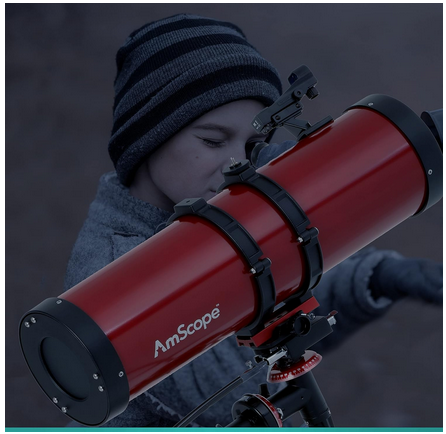
If I want a telescope that makes tracking celestial objects easier and provides a solid foundation for astrophotography, a telescope with an equatorial mount is one of the best investments I can make.
Unlike standard mounts, equatorial mounts are designed to follow the motion of the night sky with greater accuracy, making it easier to keep planets, stars, and deep sky objects centered in view.
They are especially valuable for long observing sessions and capturing detailed astronomical images. In this guide, I’ll explore the best telescopes with equatorial mounts available today, highlighting their key features, strengths, and performance.
I’ll also share my top picks, provide a helpful buying guide to simplify your decision, and answer some frequently asked questions so you can choose the right telescope for your observing and astrophotography goals.
Best Telescopes With Equatorial Mount
1) Sky-Watcher EQ6-R
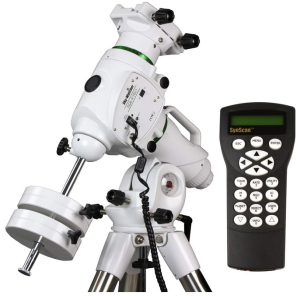
The Sky-Watcher EQ6-R is one of the best telescopes with an equatorial mount for amateur and advanced astronomers who need a reliable platform for both visual observing and astrophotography.
Designed with precision tracking, a substantial payload capacity, and user-friendly features, this mount delivers the stability and accuracy needed for capturing detailed celestial images and enjoying extended observing sessions.
Its robust construction and advanced motor system make it a dependable choice for serious skywatchers.
One of the most impressive aspects of the EQ6-R is its computerized GoTo German equatorial mount system. The mount can automatically locate and accurately track thousands of celestial objects, allowing users to spend more time observing and less time searching.
Whether you are viewing planets, star clusters, galaxies, or nebulae, the mount maintains smooth and precise tracking that is essential for both visual astronomy and long-exposure astrophotography.
The EQ6-R utilizes belt-driven stepper motors that provide exceptionally quiet operation while maintaining outstanding pointing accuracy. This design significantly reduces periodic error compared to traditional gear-driven systems, helping astrophotographers achieve sharper images with fewer tracking corrections.
The smooth slewing performance also enhances the overall observing experience, especially during nighttime sessions where minimal noise is appreciated.
With a generous 44-pound payload capacity, the EQ6-R can comfortably support a wide range of optical tubes, cameras, guide scopes, and imaging accessories. Its all-metal construction contributes to excellent stability and durability, ensuring dependable performance even when carrying heavier equipment.
This versatility makes it suitable for users who may upgrade their telescope setup over time.
Polar alignment is simplified through the built-in illuminated polar finderscope, allowing users to achieve accurate alignment quickly and efficiently. Precise polar alignment is critical for successful tracking and imaging, and this integrated feature helps reduce setup time while improving overall performance.
The included SynScan hand controller provides access to a database containing more than 42,000 celestial objects. From popular deep-sky targets to lesser-known astronomical wonders, the extensive catalog offers endless opportunities for exploration.
The intuitive interface helps both newcomers and experienced observers navigate the night sky with confidence.
Despite its heavy-duty construction, the EQ6-R remains surprisingly manageable to transport thanks to its integrated carrying handle.
Combined with its sturdy 2-inch tripod legs and straightforward setup process, the mount balances portability with the stability required for demanding astronomical applications.
Pros
- Highly accurate computerized GoTo tracking system
- Belt-driven stepper motors provide smooth and quiet operation
- Minimal periodic error for improved astrophotography results
- Strong 44-pound payload capacity
- Durable all-metal construction
- Built-in illuminated polar finderscope for easier alignment
- Extensive database of over 42,000 celestial objects
- Stable tripod with 2-inch diameter legs
- Integrated handle simplifies transportation and setup
- Suitable for both visual observing and astrophotography
Cons
- Heavier than many entry-level equatorial mounts
For astronomers seeking a powerful and accurate equatorial mount, the Sky-Watcher EQ6-R offers an outstanding combination of precision tracking, payload capacity, and advanced features. Its ability to support demanding astrophotography setups while remaining practical for visual observation makes it one of the top choices in its class.
2) Askar 130PHQ Telescope
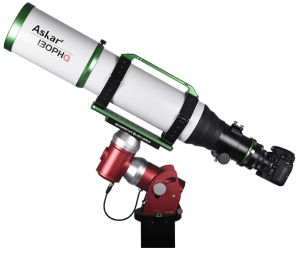
The Askar 130PHQ Telescope is one of the best telescopes with an equatorial mount for astrophotographers who demand exceptional optical performance and a streamlined imaging experience.
Designed as a long focal ratio flatfield astrograph, the 130PHQ eliminates many of the common challenges associated with astrophotography. Instead of purchasing additional field flatteners, calculating backfocus distances, or making complex optical adjustments, users can simply attach their imaging equipment, achieve focus, and begin capturing high quality astronomical images.
Featuring a 130mm aperture and a 1000mm focal length, the 130PHQ delivers impressive light gathering capability and detailed image resolution. Its focal ratio of f/7.7 provides excellent magnification for capturing galaxies, nebulae, star clusters, and other deep sky objects.
Compared to smaller models in the series, the larger aperture allows more light to reach the sensor, improving image quality and revealing finer details in celestial targets.
The optical design consists of a quadruplet lens system incorporating two ED glass elements. This advanced configuration effectively controls chromatic aberration and other optical distortions that can affect image quality.
The result is sharp, high contrast images with excellent color correction across the entire field of view, making the telescope an outstanding choice for serious astrophotography applications.
One of the major advantages of the 130PHQ is its self flattening optical design. This integrated flatfield system supports a medium format 60mm image circle and produces remarkably consistent star shapes from the center of the image to the edges.
Peripheral star distortion is minimal, while the central RMS radius remains below 2 microns, helping photographers achieve professional level results without additional corrective accessories.
The telescope is engineered with premium construction throughout. It features a telescopic dew shield, a precision CNC machined tube, durable painted finishes, and attractive decorative details.
The robust 3.4 inch focuser provides smooth and precise focusing performance while accommodating a variety of imaging setups through the included M68, M54, and M48 adapters. A finder base is also included for added convenience.
For photographers seeking faster imaging performance, the optional 3 inch 0.7x flat field reducer transforms the telescope into an f/5.4 system with a focal length of 700mm. This configuration shortens exposure times while expanding the field of view, providing greater flexibility for capturing a wider range of celestial objects.
Practical features further enhance usability. The multifunctional handle includes a central slot and M6 mounting point for attaching accessories, while the standard Losmandy dovetail plate and sturdy dual tube rings provide secure mounting on an equatorial mount.
This combination ensures excellent stability for both visual observation and demanding astrophotography sessions.
Pros
- Self flattening optical design eliminates the need for additional field flatteners
- Large 130mm aperture gathers substantial light for deep sky imaging
- Long 1000mm focal length provides excellent detail and resolution
- Quadruplet lens design with two ED elements delivers outstanding color correction
- Supports a large 60mm image circle for medium format imaging
- Very low peripheral star distortion across the field
- High quality CNC machined construction
- Large 3.4 inch focuser supports heavy imaging equipment
- Includes multiple adapters for broad camera compatibility
- Compatible with an optional reducer for faster imaging
- Strong mounting hardware enhances stability on equatorial mounts
Cons
- Larger size and weight require a capable equatorial mount
For astrophotographers looking for a premium flatfield refractor, the Askar 130PHQ Telescope delivers exceptional optical quality, advanced imaging performance, and outstanding convenience.
Its self flattening design, large image circle support, and precision construction make it an excellent choice for capturing detailed and highly accurate images of the night sky.
3) SQA106 Telescope
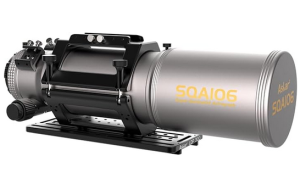
The SQA106 Telescope is one of the best telescopes with an equatorial mount for astrophotographers seeking premium optical performance and a simplified imaging workflow.
Designed as a high end astrograph, this telescope combines advanced optics, a self flattened imaging system, and precision engineering to deliver sharp, detailed astronomical images.
When paired with a quality equatorial mount, the SQA106 becomes a powerful platform for capturing deep sky objects with exceptional accuracy.
The telescope features a sophisticated quintuplet air spaced lens design that includes two SD glass elements. This optical configuration provides excellent correction of chromatic aberration while maintaining high contrast and sharpness throughout the image.
The result is outstanding image quality with pinpoint stars and excellent color fidelity, making it particularly well suited for serious astrophotography.
The SQA106 supports a generous 55mm image circle, allowing it to work effectively with full frame and other large sensor cameras. Optical performance remains impressive across the field, with a central star point RMS radius of less than 1.7 microns and edge performance at 55mm remaining below 2.2 microns.
These specifications contribute to exceptionally fine star shapes and excellent image consistency from the center to the corners of the frame.
A major advantage of the SQA106 is its integrated self flattened design. Users do not need to purchase separate field flatteners or spend time calculating precise back focus distances. Once the optical tube is properly focused, imaging equipment can be attached within the supported 48mm to 78mm connection range, creating a much more straightforward setup process for astrophotography sessions.
The telescope also delivers excellent illumination across the imaging field. Relative illumination exceeds 90 percent at a 44mm image circle, helping to reduce vignetting and ensuring even brightness across captured images. Combined with strong MTF performance, this design helps reveal fine details in galaxies, nebulae, and star clusters.
Focusing is handled by a robust dual speed 2.8 inch rack and pinion focuser. The focuser offers smooth, precise adjustments and is compatible with many motorized focusing systems available today.
Its 30mm travel range and high precision engraved scale markings allow for accurate focus control, while the CNC machined barrel incorporates internal anti reflective features and matte finishes to minimize stray light and maximize image contrast.
Practical design elements enhance the telescope’s versatility. Dual finder bases located on both sides of the focuser provide convenient mounting options for finderscopes and other accessories without requiring repositioning.
The included M68, M54, and M48 adapters feature ribbed and toothed surfaces that allow easy manual rotation and secure attachment of cameras and accessories. An Oxford cloth carrying case is also included to protect the optical tube during transportation and storage.
Since the SQA106 is supplied as an optical tube assembly, users will need to purchase a compatible equatorial mount separately. When matched with a quality mount, however, this telescope offers an exceptional imaging experience for dedicated astrophotographers.
Pros
- Quintuplet lens design with two SD glass elements
- Excellent chromatic aberration correction
- Integrated self flattened optical system
- No need for additional field flatteners
- Supports a large 55mm image circle
- Extremely fine star point performance across the field
- Strong full field illumination with minimal vignetting
- Dual speed 2.8 inch rack and pinion focuser
- Compatible with many motorized focus systems
- Multiple adapter sizes included for broad accessory compatibility
- Dual finder bases provide flexible mounting options
- Oxford cloth carrying case included
Cons
- Equatorial mount must be purchased separately
For astrophotographers who prioritize image quality and ease of use, the SQA106 Telescope is an outstanding choice. Its advanced optical design, self flattened imaging system, and precision construction make it a highly capable instrument for capturing stunning deep sky photographs when paired with a suitable equatorial mount.
4) Celestron – Advanced VX 8” EdgeHD Computerized Telescope
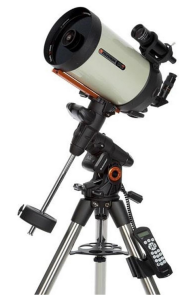
The Celestron Advanced VX 8” EdgeHD Computerized Telescope is one of the best telescopes with an equatorial mount for astronomers who want a powerful combination of visual observing performance and advanced astrophotography capabilities.
Featuring Celestron’s renowned EdgeHD optical system and the Advanced VX German equatorial mount, this telescope delivers exceptional image quality, precise tracking, and the flexibility needed for a wide range of astronomical applications.
The telescope features an 8 inch (203mm) aperture and a focal length of 2032mm, providing impressive light gathering power and high magnification for observing planets, the Moon, star clusters, nebulae, and distant galaxies.
The EdgeHD optical design corrects both coma and field curvature, producing sharp, pinpoint stars across the entire field of view rather than only at the center. This creates a flatter imaging field that is especially beneficial for astrophotography and wide field observations.
Image quality is further enhanced by Celestron’s StarBright XLT coatings. These premium coatings increase light transmission through the optical system, resulting in brighter images, improved contrast, and greater visibility of faint celestial objects.
Whether observing visually or capturing long exposure photographs, the optical performance remains impressive throughout the field.
One of the telescope’s greatest strengths is its versatility for astrophotography. Users can operate at the native f/10 focal ratio for high resolution imaging, add an optional focal reducer to achieve f/7 for a wider field of view and shorter exposures, or utilize Fastar and Hyperstar compatibility to transform the system into an ultra fast f/2 imaging platform.
This flexibility allows astrophotographers to adapt the telescope to different targets and imaging styles.
The Advanced VX German equatorial mount provides accurate computerized GoTo tracking and supports payloads up to 30 pounds. Despite being one of Celestron’s more portable equatorial mounts, it maintains excellent rigidity and stability.
The computerized tracking system automatically locates and follows celestial objects, helping observers spend more time viewing and imaging rather than manually searching the sky.
Astrophotographers will appreciate the extensive collection of advanced features built into the mount. Permanently Programmable Periodic Error Correction helps improve tracking accuracy during long exposures, while the dedicated autoguider port allows the use of guiding systems for even greater precision.
The mount also supports imaging across the meridian, reducing interruptions during extended imaging sessions.
Polar alignment is simplified through the All Star Polar Alignment system, making setup more efficient even when Polaris is not directly visible.
Users can also take advantage of CPWI software, developed in collaboration with PlaneWave Instruments, which provides observatory grade telescope control and advanced mount management capabilities.
The mount’s dual saddle dovetail system accommodates both CG 5 and CGE style dovetails, allowing compatibility with a variety of optical tubes and accessories.
The package also includes a heavy duty steel tripod, a 40mm Plossl eyepiece, a 9×50 crosshair finderscope, a star diagonal, hand controller, counterweight, and power cable, providing everything needed to begin observing right away.
Pros
- EdgeHD optical design produces sharp stars across the entire field
- Large 203mm aperture provides excellent light gathering ability
- StarBright XLT coatings improve brightness and contrast
- Supports multiple focal ratio configurations
- Compatible with Fastar and Hyperstar imaging systems
- Accurate computerized GoTo tracking
- Advanced VX equatorial mount offers strong stability
- Permanently Programmable Periodic Error Correction improves tracking performance
- Dedicated autoguider port for advanced astrophotography
- All Star Polar Alignment simplifies setup
- CPWI software provides advanced telescope control
- Dual saddle design supports multiple dovetail standards
- Complete accessory package included
Cons
- Total assembled weight may be challenging for some users to transport
For observers and astrophotographers seeking a highly capable equatorial mount telescope, the Celestron Advanced VX 8” EdgeHD Computerized Telescope delivers an exceptional balance of optical quality, imaging flexibility, and advanced tracking performance.
Its combination of EdgeHD optics and a feature rich equatorial mount makes it an excellent choice for anyone serious about exploring and photographing the night sky.
5) MEEZAA 150EQ Newtonian Reflector Telescope
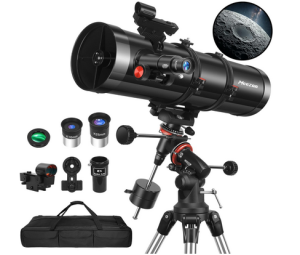
The MEEZAA 150EQ Newtonian Reflector Telescope is one of the best telescopes with an equatorial mount for beginners and intermediate stargazers who want a capable and affordable astronomy setup.
Combining a large 150mm aperture with a German equatorial mount, this telescope provides impressive views of the Moon, planets, star clusters, and many deep sky objects while helping users learn the fundamentals of celestial tracking.
Its 150mm aperture and 650mm focal length deliver strong light gathering performance, allowing observers to view brighter and more detailed astronomical targets. The large mirror collects enough light to reveal lunar craters, planetary features, and many deep sky objects with impressive clarity.
For those interested in exploring beyond the Moon and planets, the telescope offers the brightness needed to enjoy many nebulae and star clusters under dark skies.
The Newtonian reflector optical design provides clear, high contrast images while maintaining a relatively compact tube size. Included with the telescope are 25mm and 10mm Kellner eyepieces along with a 2X Barlow lens.
This combination creates four useful magnification options ranging from 26X to 130X, giving users flexibility when observing different celestial targets. Lower magnifications are ideal for wider views of star fields, while higher magnifications help reveal finer details on the Moon and planets.
Finding objects in the night sky is made easier with the included red dot finderscope. Once a target is located, the German equatorial mount allows smooth manual tracking using precision dials and slow motion control knobs.
This system helps users follow celestial objects as they move across the sky and provides an excellent introduction to equatorial mount operation for those interested in developing more advanced astronomy skills.
Lunar observation is particularly enjoyable thanks to the included moon filter. By reducing glare from the bright lunar surface, the filter improves viewing comfort and helps reveal more subtle surface details. This accessory is especially useful during observations of the full Moon and other bright lunar phases.
The telescope is supported by a heavy duty stainless steel tripod that offers good stability during observing sessions. Adjustable height settings allow users to customize the setup for comfortable viewing positions, while the integrated accessory tray keeps eyepieces and accessories within easy reach.
Despite its solid construction, the entire system remains portable enough for transport to darker observing locations.
Another advantage is the generous accessory package. The telescope includes a smartphone adapter that allows users to capture images through the eyepiece and share their observations. A large carry bag is also provided, making storage and transportation much easier. Assembly is straightforward and requires no tools, helping new users get started quickly.
Customer feedback has been particularly positive regarding optical quality, overall value, and the included accessories. Many users appreciate the balance between performance and affordability, while some note that the instructions could be more detailed, making online video tutorials a helpful supplement during setup.
Pros
- Large 150mm aperture provides bright and detailed views
- Newtonian reflector design offers strong optical performance
- German equatorial mount supports accurate manual tracking
- Precision dials and slow motion controls are easy to use
- Four magnification options included
- Moon filter improves lunar observing comfort
- Red dot finderscope simplifies target acquisition
- Heavy duty stainless steel tripod provides good stability
- Smartphone adapter included for basic astrophotography
- Large carry bag enhances portability
- No tools required for assembly
- Excellent value for money
- Wide compatibility with 1.25 inch accessories
Cons
- Manual tracking requires practice for beginners
For beginners and hobbyists looking for an affordable telescope with an equatorial mount, the MEEZAA 150EQ Newtonian Reflector Telescope offers an impressive combination of aperture, tracking capability, portability, and included accessories.
Its strong optical performance and beginner friendly design make it an excellent choice for learning astronomy while enjoying rewarding views of the night sky.
6) Celestron CGX Equatorial 11″ EdgeHD Schmidt-Cassegrain Telescope
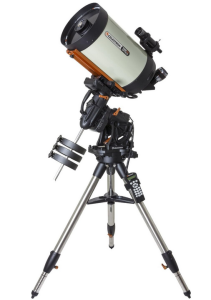
The Celestron CGX Equatorial 11″ EdgeHD Schmidt Cassegrain Telescope is one of the best telescopes with an equatorial mount for serious astronomers and astrophotographers who demand exceptional optical performance and advanced tracking capabilities.
Combining the powerful 11 inch EdgeHD optical tube with the robust CGX computerized equatorial mount, this telescope is designed to deliver outstanding visual observations and professional level imaging results.
The telescope features an impressive 279mm aperture and a 2800mm focal length, providing remarkable light gathering power and high resolution views of planets, galaxies, nebulae, globular clusters, and other deep sky objects.
Compared to smaller instruments, the 11 inch aperture collects significantly more light, revealing fainter targets and finer details.
It gathers approximately 89 percent more light than an 8 inch telescope and 40 percent more than a 9.25 inch model, making it a powerful instrument for deep sky exploration.
Its EdgeHD Schmidt Cassegrain optical design produces a flat focal plane while eliminating coma, field curvature, and other common optical aberrations. This allows stars to remain sharp and well defined across the entire imaging field.
Whether observing visually or capturing long exposure photographs, users benefit from excellent image quality from the center to the edges of the frame. The StarBright XLT coatings further enhance performance by maximizing light transmission through every optical surface.
The telescope offers exceptional versatility for astrophotography. Users can operate at the native f/10 focal ratio for detailed planetary and deep sky imaging, add an optional reducer to achieve f/7 for wider field photography, or take advantage of Fastar compatibility to reach an ultra fast f/2 configuration for dramatically shorter exposure times.
This flexibility allows the telescope to adapt to a wide variety of imaging projects.
Supporting this powerful optical system is the CGX German equatorial mount. Designed for demanding applications, the mount offers a generous 55 pound payload capacity and utilizes a smooth belt drive system for accurate tracking performance.
The sturdy 2 inch steel tripod provides excellent stability and helps minimize vibrations during observing and imaging sessions.
Tracking precision is one of the telescope’s strongest qualities. The computerized mount supports sidereal, solar, and lunar tracking rates along with both EQ North and EQ South operating modes.
These features allow users to accurately follow celestial objects across the sky, making the telescope highly effective for long exposure astrophotography and detailed visual observation.
Setup and alignment are streamlined through multiple alignment options including 2 Star Align, Solar System Align, and Last Alignment. Home sensors and limit sensors further improve operational convenience, especially for remote and automated observing setups.
Enhanced cable management also helps keep accessories organized while reducing the risk of cable snags during movement.
The included NexStar+ hand controller provides access to a database containing more than 40,000 celestial objects. Detailed information is available for over 200 objects, making exploration both educational and enjoyable.
The backlit LCD display remains easy to read during nighttime use, while USB connectivity enables direct connection to a computer for advanced control.
Included software further expands the telescope’s capabilities. CPWI Telescope Control Software delivers observatory style mount management and precise control functions, while Celestron Starry Night Special Edition software helps users plan observing sessions and explore detailed simulations of the night sky.
Additional features enhance both imaging and usability. Mirror clutches and flexible tension clutches help reduce image shift during long exposures, while cooling vents with integrated dust filters improve thermal stability and protect internal optics. Polar alignment adjustments have also been refined to simplify setup compared to earlier mount designs.
Pros
- Large 11 inch aperture delivers exceptional light gathering ability
- EdgeHD optical design produces a flat and highly corrected field
- Eliminates coma and field curvature across the image
- StarBright XLT coatings improve brightness and contrast
- Supports f/10, f/7, and f/2 imaging configurations
- Fastar compatible for ultra fast astrophotography
- CGX mount provides excellent stability and tracking accuracy
- Generous 55 pound payload capacity
- Smooth belt drive system enhances tracking performance
- Multiple alignment options simplify setup
- Home and limit sensors support advanced operation
- Database contains more than 40,000 celestial objects
- CPWI and Starry Night software included
- Mirror clutches help reduce image shift
- Cooling vents improve thermal performance
Cons
- High purchase price may exceed many budgets
For astronomers seeking a premium equatorial mount telescope capable of delivering exceptional visual observations and advanced astrophotography results, the Celestron CGX Equatorial 11″ EdgeHD Schmidt Cassegrain Telescope is an outstanding choice.
Its combination of powerful optics, precision tracking, extensive software integration, and imaging flexibility makes it one of the most capable telescope systems available for serious astronomy enthusiasts.
7) Celestron 1400 HD Telescope with CGX-L Equatorial Mount
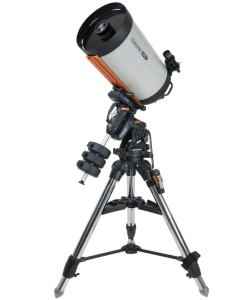
The Celestron 1400 HD Telescope with CGX L Equatorial Mount is one of the best telescopes with an equatorial mount for experienced astronomers and dedicated astrophotographers who demand exceptional optical performance and professional level tracking capabilities.
Combining a massive 14 inch EdgeHD optical system with the powerful CGX L computerized equatorial mount, this telescope is designed to deliver breathtaking views of the Moon, planets, and deep sky objects while supporting advanced imaging applications.
The telescope features a large 355mm aperture and a focal length of 3910mm, providing outstanding light gathering ability and remarkable image resolution. This substantial aperture allows observers to reveal faint galaxies, nebulae, globular clusters, and fine planetary details that smaller telescopes simply cannot match.
Whether used for visual observation or imaging, the telescope delivers bright and detailed views of celestial targets across the night sky.
Its EdgeHD Schmidt Cassegrain optical design provides a highly corrected field with excellent sharpness throughout the image. Unlike traditional Schmidt Cassegrain systems, the EdgeHD design reduces optical aberrations and delivers a flatter field, making it particularly valuable for astrophotography.
The premium StarBright XLT coatings applied to all optical surfaces maximize light transmission, improving image brightness, contrast, and overall clarity.
Visual observers will appreciate the included 2 inch Plossl eyepiece and 2 inch star diagonal. The larger diagonal provides a more comfortable viewing position when observing objects positioned high overhead, helping reduce strain during extended observing sessions.
The included 9×50 finderscope with quick release bracket also simplifies locating celestial objects and speeds up telescope setup.
Supporting the optical tube is the CGX L computerized German equatorial mount. Engineered to handle Celestron’s largest optical tubes and complete imaging systems, this mount delivers the stability and precision required for demanding astronomical applications.
Computerized GoTo technology automatically locates and tracks celestial objects, allowing users to spend more time observing and imaging rather than manually navigating the sky.
The CGX L mount incorporates several design improvements that enhance performance. A larger worm wheel contributes to more accurate tracking, while the longer dovetail saddle improves balance and stability when using heavier imaging equipment.
The mount’s sturdy and ergonomic construction makes operation more comfortable while supporting the rigors of long term use.
Astrophotographers will appreciate the mount’s remote operation friendly design. Compatibility with laptops, tablets, smartphones, and modern wireless accessories allows users to control the telescope from a distance, making imaging sessions more efficient and convenient.
This flexibility is especially valuable for remote observatories and automated imaging setups.
The heavy duty stainless steel tripod provides a solid foundation for the entire system. Its adjustable height range from 38 to 55 inches allows users to customize the setup for comfortable viewing and imaging.
The tripod helps minimize vibrations and maintains stability even when supporting the telescope’s substantial optical tube and accessories.
With support for advanced imaging equipment, excellent optical correction, and highly accurate computerized tracking, the Celestron 1400 HD is built for users who want a premium observing and astrophotography platform capable of delivering exceptional results.
Pros
- Large 14 inch aperture gathers an impressive amount of light
- EdgeHD optical design provides a flatter and more corrected field
- StarBright XLT coatings enhance brightness and contrast
- Excellent performance for visual observing and astrophotography
- CGX L mount offers highly accurate computerized tracking
- Larger worm wheel improves tracking precision
- Longer dovetail saddle enhances balance and stability
- Compatible with laptops, tablets, smartphones, and wireless accessories
- Remote operation friendly design
- Heavy duty stainless steel tripod provides strong support
- Adjustable tripod height increases user comfort
- Included 9×50 finderscope simplifies target acquisition
- 2 inch star diagonal offers comfortable viewing angles
Cons
- Premium price places it beyond many hobbyist budgets
For serious astronomers seeking one of the most capable telescope systems available, the Celestron 1400 HD Telescope with CGX L Equatorial Mount delivers exceptional optical quality, advanced tracking performance, and outstanding imaging potential.
Its combination of a massive EdgeHD optical tube and precision equatorial mount makes it an excellent choice for users who want professional level results from their observing and astrophotography sessions.
8) AmScope Reflector EQ Telescope
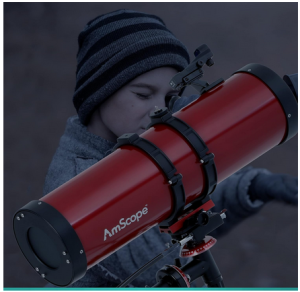
The AmScope Reflector EQ Telescope is one of the best telescopes with an equatorial mount for beginners and intermediate astronomy enthusiasts who want a capable observing system without the complexity of computerized mounts.
Featuring a 130mm Newtonian reflector, a German equatorial mount, and a generous collection of accessories, this telescope provides an excellent balance of performance, versatility, and affordability for exploring the night sky.
With a 130mm aperture and a 650mm focal length, this reflector telescope gathers enough light to reveal impressive views of the Moon, planets, star clusters, and many brighter deep sky objects.
The f/5 focal ratio delivers bright images and a relatively wide field of view, making it suitable for both planetary observations and sweeping views of larger celestial targets. The multi coated optics help improve light transmission, resulting in brighter and clearer images with improved contrast.
The Newtonian reflector design offers excellent value for observers seeking maximum aperture at an affordable price. Its optical system produces sharp views while maintaining a manageable tube size.
The telescope’s field of view of 4.6 degrees allows users to observe larger portions of the sky, which is especially useful when viewing star fields, open clusters, and larger nebulae.
Included with the telescope are three 1.25 inch eyepieces measuring 26mm, 9mm, and 6.3mm. These eyepieces provide a range of magnification options suitable for different observing targets.
The included 2X Barlow lens doubles the magnification of each eyepiece, effectively expanding the available viewing choices. Combined, these accessories allow users to achieve magnifications ranging from 25X up to 206X.
The German equatorial mount is one of the telescope’s most valuable features. Designed with slow motion control cables, it allows smooth and precise tracking of celestial objects as they move across the sky.
Once properly aligned with Earth’s rotational axis, the mount makes it easier to follow planets, the Moon, and stars during extended observing sessions. This design also provides an excellent learning platform for users interested in developing more advanced astronomy skills.
Locating objects is simplified by the included Red Dot Finder, which helps users quickly aim the telescope toward targets in the night sky. The erect image diagonal adds versatility by producing correctly oriented views, making the telescope more convenient for certain terrestrial observations as well.
The telescope is supported by a full height stainless steel tripod that provides a stable observing platform. A built in accessory tray keeps eyepieces and accessories organized and easily accessible during viewing sessions.
The counterweight shaft and two included counterweights help maintain proper balance and smooth telescope movement across the mount.
Another advantage is the telescope’s compatibility with smartphones and cameras, allowing users to experiment with basic astrophotography. While the system is primarily designed for visual observing, the ability to attach imaging devices provides additional flexibility for capturing lunar and planetary images.
Suitable for users aged 12 and older, the AmScope Reflector EQ Telescope offers a rewarding introduction to astronomy while providing enough capability to keep many enthusiasts engaged for years.
Pros
- Large 130mm aperture provides bright and detailed views
- Fast f/5 focal ratio delivers wide field observations
- Multi coated optics improve image brightness and contrast
- German equatorial mount supports accurate object tracking
- Slow motion control cables allow smooth adjustments
- Three eyepieces included for multiple viewing options
- 2X Barlow lens expands magnification range
- Red Dot Finder simplifies object location
- Stainless steel tripod offers solid stability
- Counterweight system improves balance and handling
- Compatible with smartphones and cameras
- No power source required for operation
- Good value for beginners and hobbyists
Cons
- Manual tracking requires practice and patience
For beginners and astronomy enthusiasts looking for a dependable telescope with an equatorial mount, the AmScope Reflector EQ Telescope delivers strong optical performance, smooth tracking capabilities, and a comprehensive accessory package.
Its combination of aperture, versatility, and user friendly design makes it an excellent choice for exploring the Moon, planets, and many deep sky objects.
Next read: 8 Best Red Dots For A Glock 43X
Factors To Consider When Choosing The Best Telescopes With Equatorial Mount
1. Aperture Size
Aperture is one of the most important factors because it determines how much light the telescope can collect. Larger apertures produce brighter images, reveal fainter deep sky objects, and provide greater detail on planets and the Moon.
If your primary interest is observing galaxies, nebulae, and star clusters, choosing a telescope with a larger aperture can significantly improve your viewing experience. However, larger apertures often increase the size, weight, and cost of the telescope.
2. Optical Design
Telescopes with equatorial mounts are available in several optical designs, including refractors, reflectors, and Schmidt Cassegrain systems. Each design offers different strengths. Refractors generally provide sharp, high contrast images with minimal maintenance.
Reflectors offer large apertures at a lower cost. Catadioptric designs combine compact size with long focal lengths and versatile performance. Selecting the right optical design depends on your observing goals, budget, and portability requirements.
3. Mount Stability and Payload Capacity
The quality of the equatorial mount is just as important as the optical tube. A sturdy mount minimizes vibrations and provides smoother tracking during observation and imaging sessions.
Payload capacity should comfortably support the telescope along with any accessories such as cameras, guide scopes, filter wheels, and focus motors. An underpowered mount can negatively affect tracking accuracy and image quality.
4. Tracking and GoTo Capabilities
Many modern equatorial mounts include computerized GoTo systems that automatically locate and track celestial objects. Accurate tracking is particularly important for astrophotography because even small tracking errors can affect long exposure images.
Consider whether you prefer a manual mount for learning celestial navigation or a computerized system that simplifies object location and tracking.
5. Astrophotography Compatibility
If you plan to capture images of celestial objects, choose a telescope designed with astrophotography in mind. Features such as flat field optics, reduced optical aberrations, autoguider ports, periodic error correction, and compatibility with imaging accessories can make a significant difference.
Some telescopes are optimized specifically for photography, while others are better suited for visual observation.
6. Focuser Quality
A high quality focuser improves both observing and imaging performance. Precision focusing is essential for obtaining sharp images, especially at higher magnifications or during astrophotography sessions.
Dual speed focusers, large diameter focusers, and motorized focuser compatibility can provide greater accuracy and convenience when adjusting focus under varying observing conditions.
7. Portability and Ease of Setup
Large telescopes often provide superior performance, but they can also be heavy and time consuming to transport and assemble. Consider how frequently you plan to move your telescope and whether you will use it primarily in your backyard or at remote observing sites.
Features such as carrying handles, compact tube designs, quick release systems, and manageable component weights can make setup much easier.
8. Included Accessories and Expandability
The accessories included with a telescope can greatly influence its overall value. Useful additions may include eyepieces, finderscopes, star diagonals, camera adapters, carrying cases, and software.
It is also important to consider future expansion options. A telescope that supports additional accessories, imaging equipment, upgraded focusers, and advanced control systems will provide more flexibility as your astronomy skills and interests develop.
Next read: 7 Best Telescopes With A Digital Camera
Advantages Of Using Telescopes With Equatorial Mount
1. Easier Tracking of Celestial Objects
One of the biggest advantages of an equatorial mount is its ability to follow celestial objects smoothly as they move across the sky. Once the mount is properly aligned with Earth’s rotational axis, users only need to adjust a single axis to keep an object centered in the eyepiece.
This makes observing planets, stars, and deep sky objects much more convenient, especially during extended viewing sessions.
2. Excellent for Astrophotography
Equatorial mounts are the preferred choice for astrophotography because they are specifically designed to compensate for Earth’s rotation. Accurate tracking allows cameras to capture long exposure images without significant star trailing.
This capability is essential when photographing faint galaxies, nebulae, and star clusters that require extended exposure times to reveal detail.
3. Greater Tracking Accuracy
Many equatorial mounts provide highly precise tracking performance, particularly when equipped with computerized motors and advanced control systems.
Accurate tracking keeps celestial objects centered for longer periods, reducing the need for constant manual adjustments. This improves both visual observation and imaging results while creating a more enjoyable observing experience.
4. Better High Magnification Viewing
When observing at high magnifications, celestial objects appear to move through the field of view more quickly. An equatorial mount makes it easier to keep these objects centered by allowing smooth adjustments along a single tracking axis.
This is especially beneficial when studying fine details on the Moon, planets, and double stars where steady viewing is important.
5. Supports Advanced Astrophotography Equipment
Equatorial mounts are often designed to accommodate cameras, guide scopes, focus motors, filter wheels, and other imaging accessories. Their robust construction and higher payload capacities allow users to build advanced imaging setups without compromising stability.
This makes them ideal for astronomers who plan to expand their equipment over time.
6. Computerized GoTo Functionality
Many modern equatorial mounts include computerized GoTo technology that can automatically locate and track thousands of celestial objects. This feature saves time by eliminating much of the manual searching process.
Beginners can quickly find interesting targets, while experienced observers can efficiently explore large numbers of objects during a single observing session.
7. Improved Long Duration Observing Sessions
Because equatorial mounts continuously track celestial objects, observers can spend more time studying details rather than constantly repositioning the telescope.
This is particularly useful during public outreach events, planetary observation sessions, and deep sky viewing where maintaining an object in the center of the field enhances the overall experience.
8. Reduced Image Drift During Imaging
For astrophotographers, image drift can ruin otherwise excellent photographs. Equatorial mounts minimize this issue by accurately following the apparent motion of celestial objects.
The improved tracking performance helps maintain sharp stars and detailed images throughout lengthy exposures, reducing the number of unusable frames.
9. Versatility for Different Astronomy Interests
Equatorial mounts can be used effectively for visual observing, lunar photography, planetary imaging, and deep sky astrophotography. Their flexibility makes them suitable for a wide range of astronomy activities.
Whether someone is just beginning to explore the night sky or pursuing advanced imaging projects, an equatorial mount can adapt to evolving interests and skill levels.
10. Professional Level Observing Experience
Using an equatorial mount introduces astronomers to the same tracking principles employed by many professional observatories. Features such as polar alignment, precise tracking controls, computerized object databases, and advanced software integration provide a more sophisticated observing experience.
This allows users to develop valuable astronomy skills while achieving better results from their equipment.
Best Telescopes With Equatorial Mount FAQs
1. Why is an equatorial mount better for astronomy than a standard alt azimuth mount?
An equatorial mount is designed to align with Earth’s rotational axis, allowing it to track celestial objects using a single axis of movement. This makes it much easier to keep planets, stars, and deep sky objects centered in the field of view as they move across the sky.
Equatorial mounts are especially valuable for astrophotography because their tracking system helps reduce image blur and star trailing during long exposures.
2. Are telescopes with equatorial mounts suitable for beginners?
Yes, many telescopes with equatorial mounts are suitable for beginners, although there can be a learning curve when it comes to polar alignment and mount operation.
Once users understand the basics, equatorial mounts often provide a more rewarding observing experience because they make object tracking much easier. Beginner friendly models typically include slow motion controls or computerized GoTo systems that simplify navigation and tracking.
3. What size telescope should I choose with an equatorial mount?
The ideal telescope size depends on your observing goals, budget, and portability needs. Smaller telescopes are easier to transport and set up, making them a good choice for beginners and casual observers.
Larger aperture telescopes collect more light and reveal greater detail in celestial objects, making them better suited for serious visual observation and astrophotography. It is important to choose a mount with sufficient payload capacity to support the telescope and any future accessories you may add.
Conclusion
In conclusion, the best telescopes with equatorial mounts offer a powerful combination of accurate tracking, stable performance, and exceptional viewing capabilities for both visual observation and astrophotography.
Whether you are a beginner learning the night sky or an experienced astronomer capturing detailed images of distant galaxies and nebulae, an equatorial mount can make observing more enjoyable and efficient by smoothly following celestial objects as they move across the sky.
The top models stand out for their quality optics, reliable mount systems, sturdy construction, and compatibility with a wide range of accessories. By choosing a telescope that matches your observing goals, experience level, and budget, you can enjoy clearer views, easier tracking, and a more rewarding astronomy experience for years to come.